
FEDERAL REGULATIONS
U.S. Congress - Achieving a Better Life Experience Act of 2014
H.R.647 - ABLE Act of 2014
https://www.congress.gov/bill/113th-congress/house-bill/647#:~:text=Imposes%20an%20additional%2010%25%20tax,ABLE%20account%20for%20disability%20expenses.
U.S. Department of the Treasury
ABLE Accounts - Tax Benefit for People with Disabilities
https://www.irs.gov/government-entities/federal-state-local-governments/able-accounts-tax-benefit-for-people-with-disabilities
IRS Publication 907, Tax Highlights for Persons with Disabilities for us in preparing returns
IRS issues final regulations for Achieving a Better Life Experience accounts
https://www.irs.gov/newsroom/irs-issues-final-regulations-for-achieving-a-better-life-experience-accounts
IRS issues Information Letter on ABLE Questions (June 24, 2022)
U.S. Social Security Administration (SSA)
Program Operations Manual System (POMS)
SI 01130.740; Achieving a Better Life Experience (ABLE) Accounts
https://secure.ssa.gov/poms.nsf/lnx/0501130740
U.S. Department of Health and Human Services (HHS)
Centers for Medicare & Medicaid Services
SMD# 17-002; Implications of the ABLE Act for State Medicaid Programs
https://www.medicaid.gov/federal-policy-guidance/downloads/smd17002.pdf
U.S. Department of Agriculture (USDA)
FNS-GD-2016-0018; Treatment of ABLE accounts in Determining SNAP Eligibility
https://www.fns.usda.gov/snap/treatment-able-accounts-determining-snap-eligibility
Supplemental Nutrition Assistance Program (SNAP): Eligibility
https://www.federalregister.gov/documents/2017/01/06/2016-30663/supplemental-nutrition-assistance-program-snap-eligibility-certification-and-employment-and-training#p-96
U.S. Department of Education (ED)
Free Application for Federal Student Aid (FAFSA); Funds in an ABLE Accounts are not countable assets for students of their parent during financial aide determination
https://studentaid.gov/h/apply-for-aid/fafsa
U.S. Department of Housing and Urban Development (HUD)
Notice PIH 2019-09 and Notice H-2019-06; Treatment of ABLE Accounts in HUD-Assisted Programs
https://www.hud.gov/sites/dfiles/OCHCO/documents/2019-09pihn.pdf
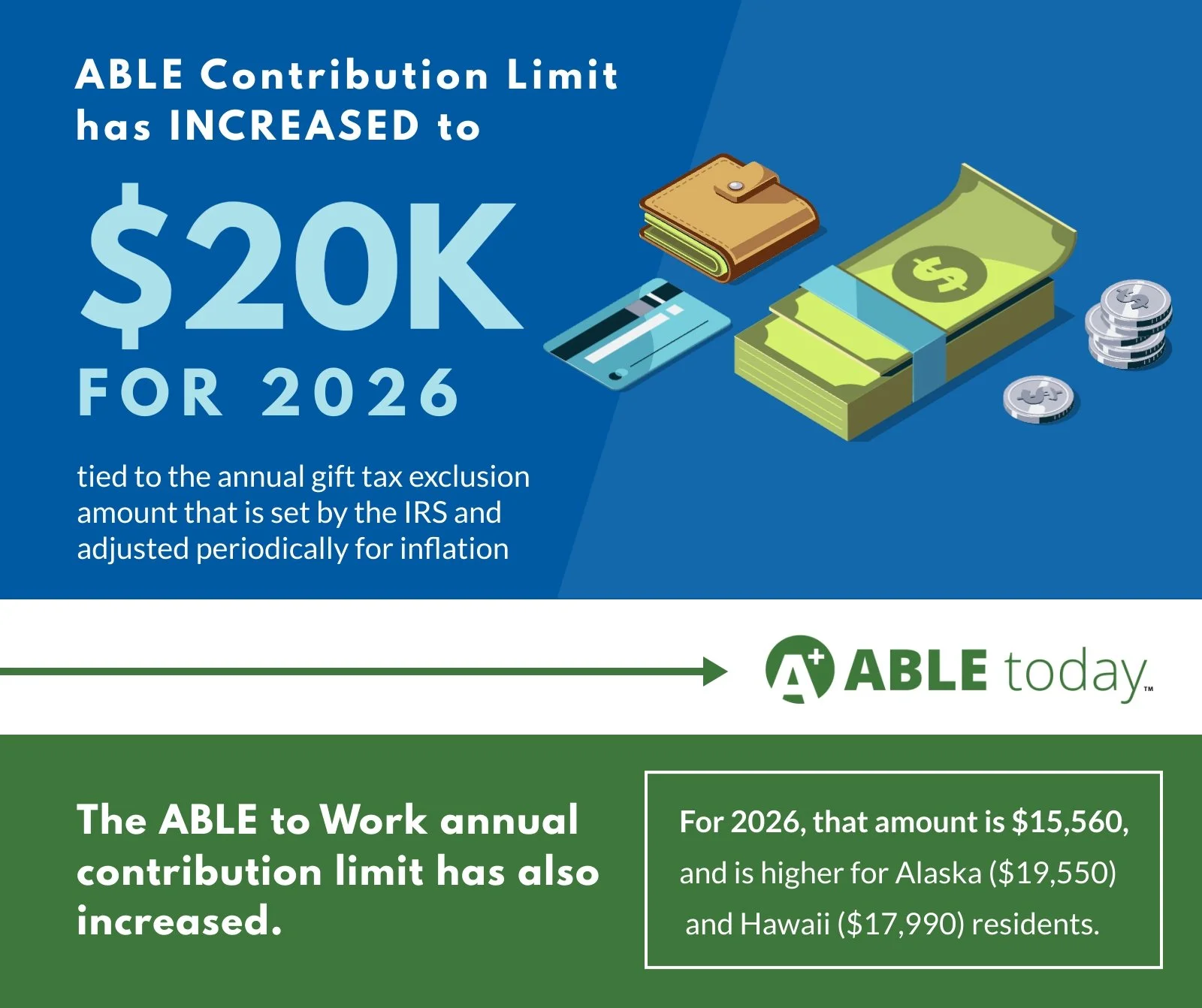
ABLE Contribution Limits Increased in 2026
The standard ABLE account annual contribution limit is $20,000 for 2026, tied to the annual gift tax exclusion amount that is set by the IRS and adjusted periodically for inflation. Contributions can come from any source including directly from the ABLE account enrollee, family, friends, organizations, nonprofits, and employers.
Some employed account owners are eligible to make additional contributions each year, above and beyond the standard $20,000 limit. Individuals are eligible for these additional contributions (sometimes called "ABLE to Work" contributions) if, in a given year, they have earned income and they have not had any contributions made to a defined contribution plan, a 403(b) annuity contract, or a 457(b) deferred compensation plan.
In 2026, the new limit ABLE to Work contributions is the lesser of either (1) the individual's earned income for the year, or (2) the prior year's federal poverty guideline for a one-person household -- which is $15,650 for residents of the 48 contiguous states, $17,990 for Hawaii residents, and $19,550 for Alaska residents. These amounts are set by HHS and are generally updated on an annual basis.
https://aspe.hhs.gov/topics/poverty-economic-mobility/poverty-guidelines